Published May 14, 2026 by Campus Information Office
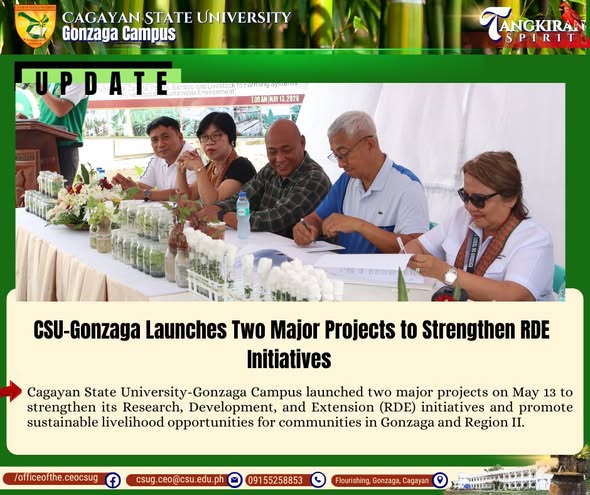
Cagayan State University-Gonzaga Campus launched two major projects on May 13 to strengthen its Research, Development, and Extension (RDE) initiatives and promote sustainable livelihood opportunities for communities in Gonzaga and Region II.
One of the projects launched was the ROOTRISE Project or “Advancing Root Crops through RDE and Entrepreneurial Management for Bamboo-based Farming Systems,” a three-year initiative running from 2026 to 2029 in partnership with local government units and the different colleges of the campus.
The ROOTRISE project was conceptualized to help address food security concerns, particularly during dry seasons when rice and vegetable production may not be suitable. Through the project, CSU-Gonzaga aims to maximize its existing resources, including the MABRIC Tissue Culture Laboratory and the Root Crops Gene Bank, which houses 19 varieties of sweet potatoes, five varieties of lowland potatoes, and several gabi/taro and ube lines adapted to local conditions and farmer preferences.
With the continued strengthening of its MABRIC facilities through accreditation efforts supported by Benguet State University-Northern Philippines Root Crops Research and Training Center, Department of Agriculture Regional Field Office 02, and University of the Philippines Diliman, CSU-Gonzaga is set to extend its facilities and technical expertise to local communities and farmers in Region II.
The project targets the assessment of root crops in the region, the production and distribution of 30,000 tissue-culture quality planting materials, the development of entrepreneurial skills among beneficiaries, and the establishment of market linkages for sustainable livelihood opportunities.
Another highlight of the event was the ceremonial signing of the Memorandum of Agreement for the joint project between CSU-Gonzaga and the Local Government Unit of Gonzaga titled “Empowering Youth, Women, Senior Citizens, and Farmers through Integration of Tissue-Cultured Banana, Camote, Potato, Bamboo, and Livestock to Farming Systems for Livelihood and Sustainable Development.”
The three-year partnership project is supported by Gonzaga Mayor, Honorable Rellie Dalmaceda, Vice Mayor Sheryl Gaspar, and the members of the Sangguniang Bayan, in collaboration with the Municipal Agriculture Office, Municipal Disaster Risk Reduction and Management Office, Municipal Environment and Natural Resources Office, and representatives from the women and youth sectors.
The project will utilize CSU-Gonzaga’s Tissue Culture Laboratory in producing high-quality planting materials to promote sustainable, eco-friendly, and income-generating agricultural practices for the local community.
During the MOA signing ceremony, Vice Mayor Gaspar, speaking on behalf of the legislative body, stated that, despite the substantial financial counterpart required from the LGU, funds were secured to support the project's implementation. She also described the initiative as beneficial to the identified stakeholders and communities.
Mr. Robert Busania highlighted the Department of Agriculture’s continuing initiatives to strengthen food security and address present agricultural challenges.
Meanwhile, Dr. Arthur Ibanez expressed gratitude to the LGU of Gonzaga for its continued support and partnership with CSU. He emphasized the importance of humility and empathy in extending services to communities and likened CSU-Gonzaga to bamboo, the campus’ niche project, for its resilience and service-oriented mission.
Mayor Dalmaceda also reaffirmed the partnership between the LGU and CSU-Gonzaga, emphasizing their shared commitment toward the progress and development of both the university and the municipality of Gonzaga.
Cagayan State University-Gonzaga Campus, through its strong partnerships with various agencies, continues to extend services to the community by sharing its technical expertise and utilizing its research facilities.
Photos: Ms. Jean Torres and Ms. Lorie Fhel Ramento