Published March 20, 2026 by Campus Information Office
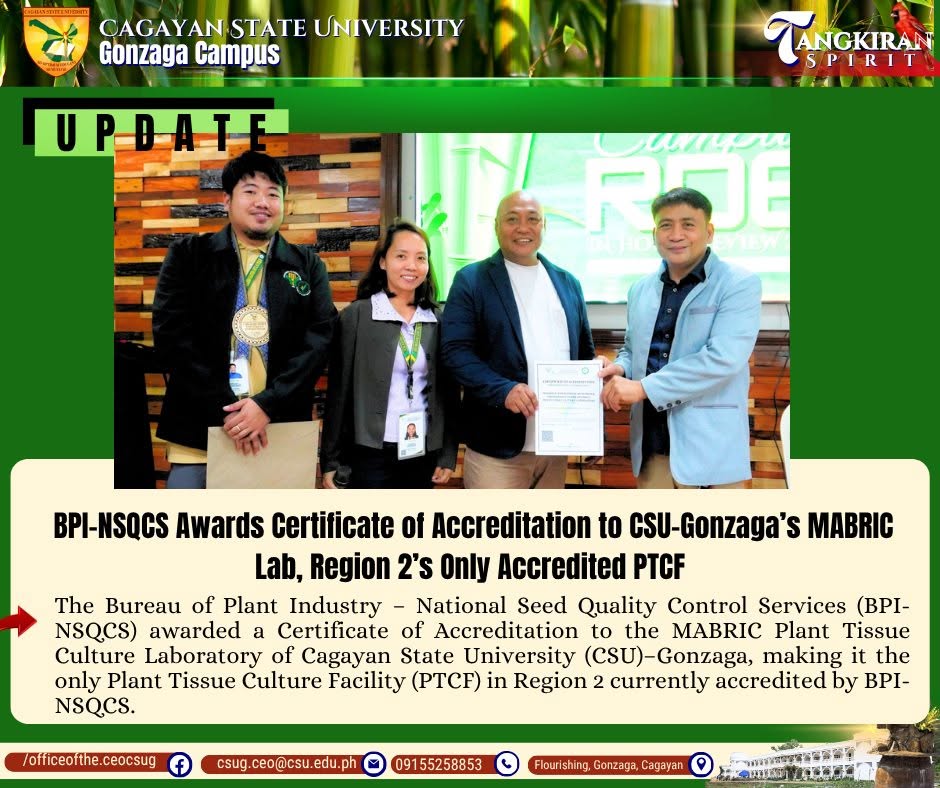
The Bureau of Plant Industry – National Seed Quality Control Services (BPI-NSQCS) awarded a Certificate of Accreditation to the MABRIC Plant Tissue Culture Laboratory of Cagayan State University (CSU)–Gonzaga, making it the only Plant Tissue Culture Facility (PTCF) in Region 2 currently accredited by BPI-NSQCS.
The Certificate of Accreditation, issued on February 23, 2026, confirms that the laboratory meets national standards for producing high-quality, disease-free planting materials. It also verifies that the facility has the required equipment, trained personnel, and established procedures for tissue culture production, waste management, and quality control.
The awarding ceremony was held on March 18, 2026, with Ms. Elijoy Cortez Eda–Acidera, Officer-in-Charge, Chief of NSQCS Region 2, leading the conferment. She commended the campus for its initiative in promoting the propagation of quality planting materials, particularly for banana-lakatan.
University Vice President for Research, Development, and Extension Engr. Audy Quebral expressed appreciation to the BPI-NSQCS for its support throughout the accreditation process and recognized the campus’s efforts in enhancing laboratory standards.
Meanwhile, CSU-Gonzaga Chief Executive Officer Froilan A. Pacris, Jr. lauded the study leaders, Ms. Myraly L. Marcos and Dr. Jayrome Butay, for their commitment in meeting the rigorous requirements for accreditation. He emphasized that the certification affirms the laboratory’s capability to consistently produce quality planting materials.
The accreditation is valid for five years.
The certification followed a successful on-site evaluation conducted on October 29–30, 2025, in accordance with Department Circular No. 3, Series of 2020, which governs the accreditation of plant tissue culture facilities to ensure compliance with national standards and the production of disease-free planting materials.
Source and Photos: Office of the Campus Extension