Published November 06, 2025 by Campus Information Office
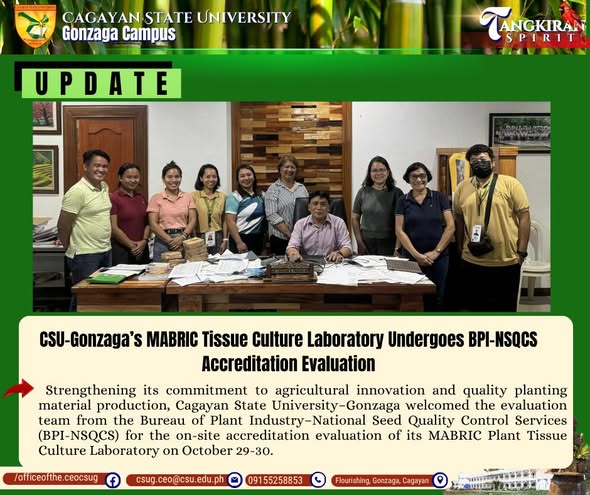
Strengthening its commitment to agricultural innovation and quality planting material production, Cagayan State University–Gonzaga welcomed the evaluation team from the Bureau of Plant Industry–National Seed Quality Control Services (BPI-NSQCS) for the on-site accreditation evaluation of its MABRIC Plant Tissue Culture Laboratory on October 29-30.
The activity forms part of the BPI-NSQCS mandate, as outlined in Department Circular No. 3, Series of 2020, which governs the accreditation of plant tissue culture facilities to ensure compliance with national standards and the production of quality, disease-free planting materials.
The evaluation team was welcomed by Campus Executive Officer Dr. Froilan A. Pacris Jr., and assisted by Dr. Jayrome Butay and Ms. Myraly Marcos, the Campus MABRIC Tissue Culture Laboratory In-Charge.
Following the submission of complete documentary requirements, CSU-Gonzaga’s facilities were deemed ready for on-site inspection by the designated evaluators. The BPI-NSQCS evaluation team was composed of Dr. Juliet Ochasan (BPI Baguio), Dr. Queenie Tabur (BPI Central Office), Ms. Aurora de Guzman, Ms. Kim Ashley Pascual (both from NSQCS Central Office), Ms. Elijoy Acidera, Engr. Jordin Tumabao, and Mr. Nicole Bagaua (NSQCS Region 2 Satellite Office).
During the evaluation, the team assessed the laboratory’s compliance with accreditation standards, including infrastructure, equipment, procedural documentation, and quality assurance systems vital for plant tissue culture operations.
CSU-Gonzaga’s bid for accreditation of the MABRIC Tissue Culture Laboratory underscores the campus’s dedication to promoting biotechnology-based agricultural practices. Once accredited, the laboratory will serve as a vital center for the production of high-quality planting materials, supporting local farmers and contributing to sustainable crop development in the Cagayan Valley region.
Source: Campus Extension Office